
Jack Manzella
August 21, 2026
Sofab Inks and Alpha Precision Systems (APS) have demonstrated 22% power conversion efficiency on a 300×300 mm perovskite solar panel using a fullerene-free PIN architecture. The panel was fabricated on production-scale slot-die coating equipment, addressing one of the persistent obstacles in perovskite commercialization: reproducing laboratory-scale performance under manufacturing conditions.
The champion panel achieved 22.243% conversion efficiency, delivering 15.058 W at a fill factor of 0.736. Open-circuit voltage measured 47.062 V with a short-circuit current of 0.435 A, corresponding to a Jsc of 25.710 mA/cm². Series resistance was 10.148 Ω.
The panel employs a PIN structure on glass and FTO, with both solution-processed layers — the perovskite absorber and Sofab's Tinfab ETL — deposited by slot-die coating.
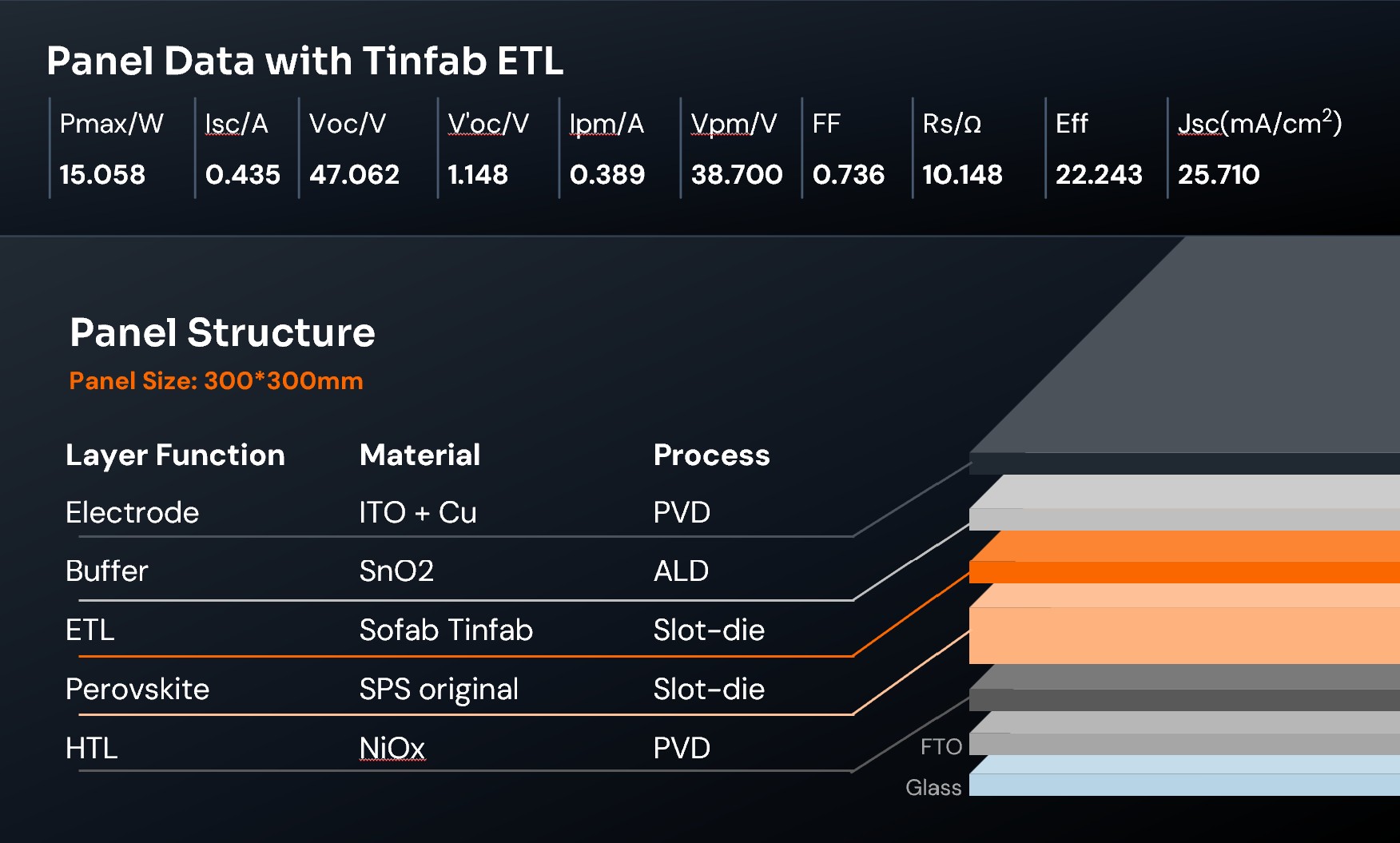
Absent from the stack is C60. Tinfab, a tin oxide–based nanoparticle ink developed by Sofab Inks, is formulated for direct deposition onto the perovskite absorber, replacing the evaporated fullerene layer conventionally used in PIN devices. Tin oxide provides favorable band alignment for electron extraction, high optical transparency, and chemical stability under illumination and heat. As an inorganic, solution-processable material, it also offers lower material cost and improved compatibility with high-throughput manufacturing.
Sofab Inks had previously reported a champion device efficiency of 20.41% on flexible substrates, establishing Tinfab's performance at laboratory scale. Translating such results into manufacturable modules presents a separate set of challenges: device architecture, materials, process conditions, and the transition from small-area deposition to large-area coating all influence film formation, drying dynamics, and coating uniformity, frequently creating a disconnect between laboratory validation and production outcomes.
To address these variables directly, Sofab Inks partnered with APS, which integrated Tinfab into its 30×30 cm slot-die coating platform — equipment representative of production tooling. The arrangement allowed both companies to fabricate complete modules in-house and to systematically vary device stacks and process parameters on manufacturing-relevant hardware rather than extrapolating from small-area cells. Multiple optimization cycles produced the 22.2% active-area champion result.
APS is the international arm of SPS China and specializes in precision slot coating technology for perovskite solar, semiconductors, and displays, with equipment supporting square-meter-scale production of single-junction and tandem perovskite cells.
In subsequent joint fabrication work at the APS facility, Tinfab-based modules underwent 85°C/85% relative humidity damp-heat testing alongside comparable C60-based control devices. The Tinfab modules maintained approximately 20% higher performance than the controls throughout most of the test period, with one module retaining 96% of its initial efficiency after 650 hours. These results indicate promising stability trends for fullerene-free architectures under accelerated aging conditions.
Sofab Inks and APS are currently conducting joint development programs with solar manufacturers, combining Sofab's materials portfolio with APS coating and vacuum-drying expertise to evaluate materials within customer-specific device architectures under manufacturing conditions.
Both companies will exhibit at Perovskite Connect 2026, taking place 21–22 October at the Estrel Convention Center in Berlin. Sofab Inks will be at booth U01 and Alpha Precision Systems at booth U00.